← All selected work

Radar meteorology · Precipitation microphysics

Raindrop microphysics across Southern China

Compared drop-size distributions across rainfall regimes and evaluated whether their microphysical signatures remained consistent along the South China coast.

Hong Kong Observatory · Presented at ERAD2022
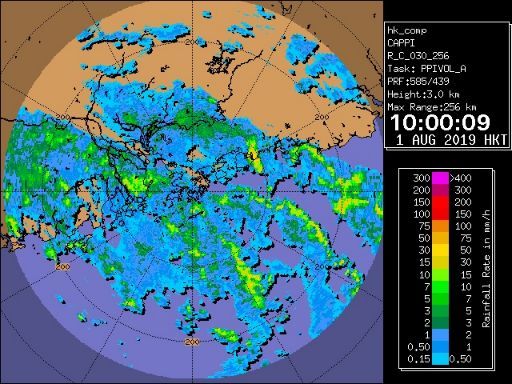
Radar reflectivity in the outer rainbands of Tropical Cyclone Wipha
Radar reflectivity associated with the outer rainbands of Tropical Cyclone Wipha on 1 August 2019.
15rainfall events
32DVD sites
1 minDSD samples
ERADconference 2022

01 / Question

Why this problem mattered

Rainfall rate alone does not tell us whether precipitation is made up of many small drops or fewer large drops. This work used two-dimensional video disdrometers to examine how those microphysical structures vary by precipitation type, storm environment and location.

02 / Approach

From physical fields to usable evidence

  1. Analysed one-minute drop-size-distribution measurements from 15 convective and stratiform rainfall events at Chek Lap Kok.
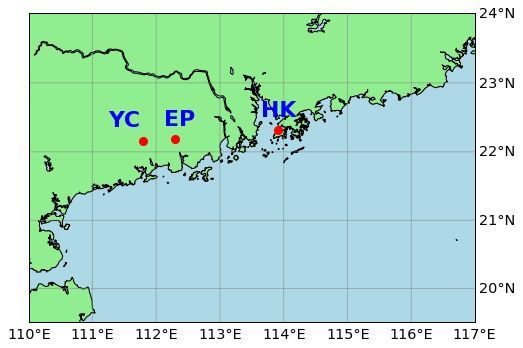
  2. Compared Hong Kong observations with instruments at Enping and Yangchun in Guangdong during the outer rainbands of Tropical Cyclone Wipha.
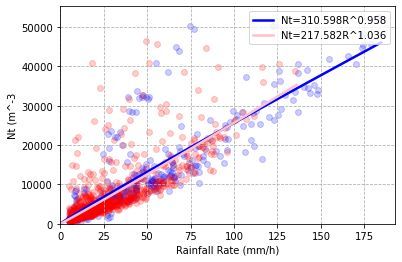
  3. Related mass-weighted mean diameter and total drop concentration to rainfall rate, supported by operational radar imagery and weather classification.

03 / Result

At high convective rain rates, concentration mattered more than continued drop growth.

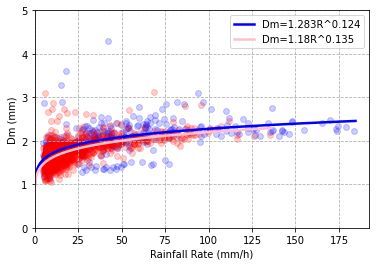
Convective rain generally contained larger drops than stratiform rain. At the highest observed convective rain rates, mass-weighted mean diameter levelled off while total drop concentration continued to rise, consistent with a balance between coalescence and breakup.

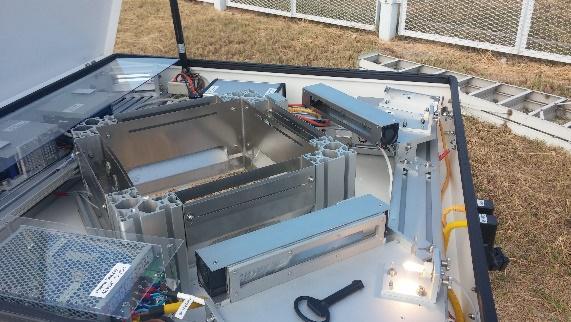
Two-dimensional video disdrometer at Chek Lap Kok
The 2DVD instrument at Chek Lap Kok, Hong Kong.
Map of the three disdrometer sites in Southern China
Observation sites at Hong Kong, Enping and Yangchun along the South China coast.
Mass-weighted mean drop diameter versus convective rainfall rate
Mass-weighted mean diameter versus rainfall rate for convective cases; red denotes tropical-cyclone scenarios.
Total drop concentration versus convective rainfall rate
Total drop concentration versus rainfall rate for convective cases.

04

Implications

The outer-rainband drop spectra from Wipha were broadly similar at Hong Kong, Enping and Yangchun. Tropical-cyclone cases also showed smaller convective–stratiform contrasts than non-cyclone cases, suggesting a more uniform microphysical environment within the sampled rainbands.

05

Limitations

The analysis was preliminary and event-based. A larger sample, consistent quality control across instruments and formal uncertainty testing would be needed before generalizing the cross-site or tropical-cyclone contrasts.