← All selected work

Climate ML · Ocean–atmosphere dynamics

Learning AMOC–NAO interactions from a large climate ensemble

Modelled Atlantic overturning circulation with lagged climate predictors, XGBoost and SHAP across a 40-member ensemble.

MSc dissertation · Imperial College London2025
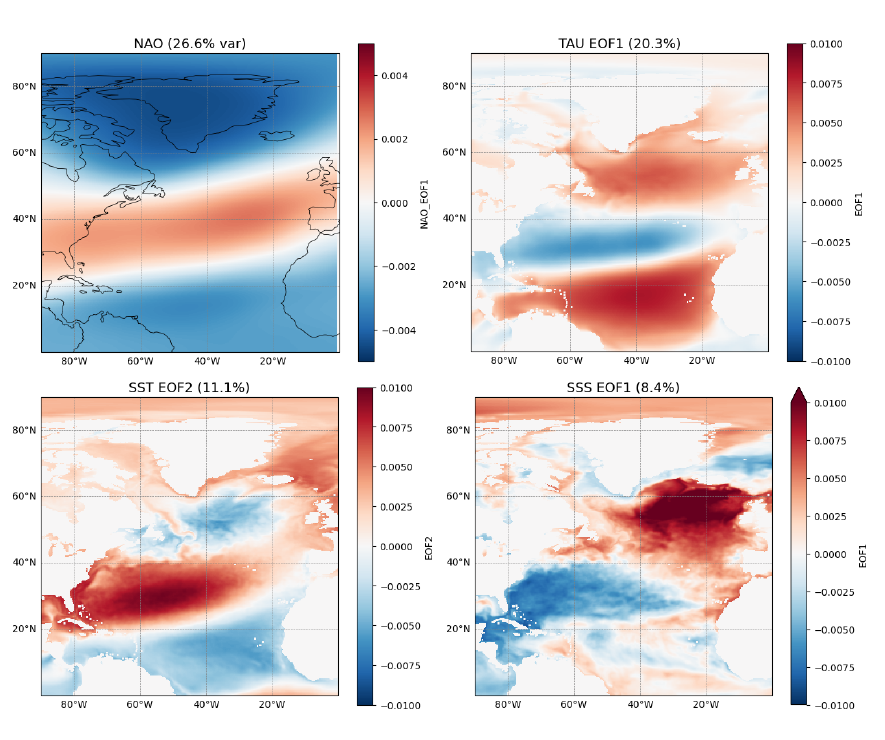
North Atlantic EOF spatial patterns used as model predictors
Selected North Atlantic EOF patterns used by the final model.
40ensemble members
31,200monthly samples
0.516test R²
0.743correlation

01 / Question

Why this problem mattered

The observational record of the Atlantic Meridional Overturning Circulation is short, while its relationship with the North Atlantic Oscillation unfolds across multiple variables and time lags. The project tested whether a large coupled-climate ensemble could provide enough examples to learn those interactions and support later reconstruction work.

02 / Approach

From physical fields to usable evidence

  1. Derived compact spatial predictors from mixed-layer depth, sea-surface height, salinity, temperature and wind stress using EOF/PCA analysis.
  2. Combined those patterns with the NAO at multiple lead times and trained gradient-boosted models across the 40-member CANARI ensemble.
  3. Compared single-member and ensemble experiments, then used SHAP values to inspect which lagged physical patterns influenced the predictions.

03 / Result

The ensemble experiment explained just over half of the held-out variance.

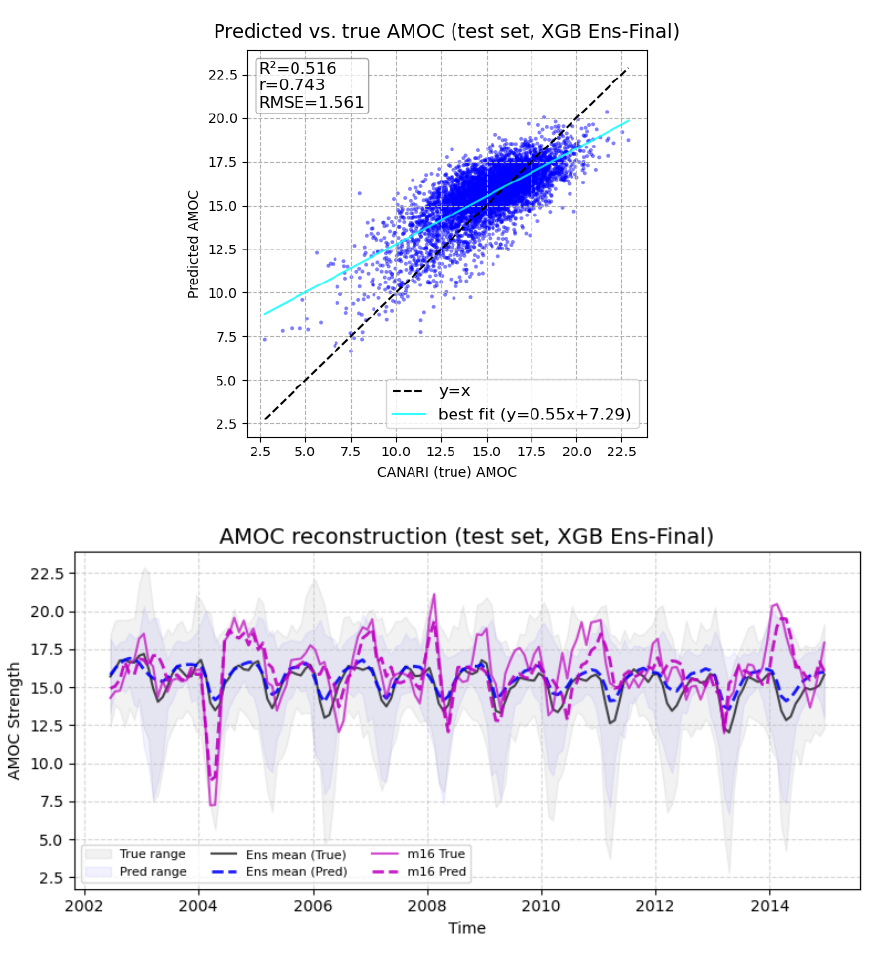
The final ensemble XGBoost configuration achieved R² = 0.516, r = 0.743 and RMSE = 1.561 on the test set. It modestly improved on the strongest single-member result while offering a broader training distribution.

Predicted versus simulated AMOC and reconstruction time series
Final ensemble XGBoost evaluation: predicted-versus-simulated AMOC and the reconstructed ensemble time series.
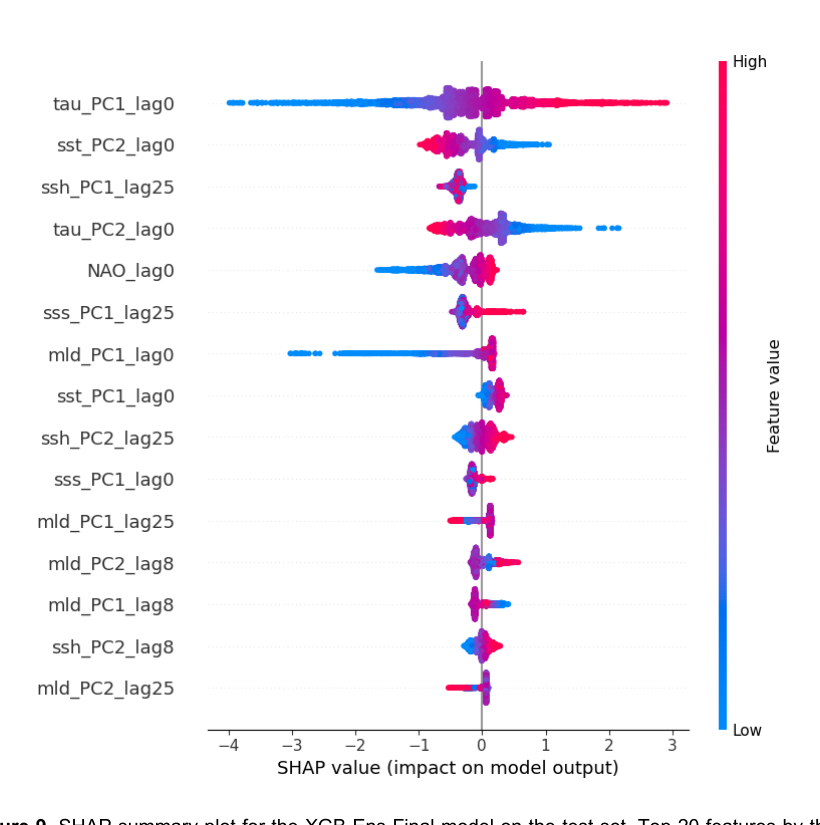
SHAP summary showing model feature influence
SHAP summary for the final model. Feature names retain the variable, principal component and lag used in the dissertation.

04

Implications

The SHAP analysis highlighted wind-stress, sea-surface-temperature, sea-surface-height and NAO signals at distinct lags. This does not establish causality, but it provides a useful bridge between predictive performance and physically recognizable modes of North Atlantic variability.

05

Limitations

Observation-based reconstruction remained preliminary. Ensemble-model relationships may not transfer cleanly to the real ocean, and the compressed EOF representation can hide regional processes. The appropriate next step is careful out-of-distribution testing against RAPID and other observational products.